

Electric-vehicle batteries and power-electronic components must operate across wide temperature ranges and rapidly changing loads. Development laboratories therefore need controlled thermal testing to evaluate performance, durability and safety under repeatable conditions. A liquid-cooled testing machine can condition coolant supplied to the device under test, while environmental chambers control the surrounding air.
Cell temperature affects internal resistance, charge acceptance, available power and aging. Temperature differences across a module or pack can create uneven performance. During development, test equipment must reproduce relevant coolant temperatures and flow conditions so engineers can evaluate how the pack responds.
An environmental test chamber controls air temperature and sometimes humidity around a component. A liquid cooling test system controls temperature and flow of coolant through a battery cold plate or liquid circuit. Many validation programs use both: the chamber reproduces ambient conditions while the coolant conditioner simulates the vehicle thermal-management loop. For equipment options related to this requirement, review Tekin Cooling’s high and low temperature liquid-cooled testing systems for relevant configurations.
Thermal cycling equipment repeatedly moves a component through defined temperature ranges to evaluate durability. Thermal shock applies more abrupt transitions. For liquid-cooled components, the coolant loop must achieve the requested ramp rate without unstable overshoot. Heater capacity, refrigeration capacity, fluid volume, pump response and heat-exchanger design all influence the profile.
Battery cooling systems are sensitive to hydraulic conditions. The test system should reproduce specified flow and pressure while protecting the device under test. Coolant chemistry must be compatible with pumps, seals, sensors and heat exchangers. Glycol concentration also affects viscosity and pump performance at low temperature.
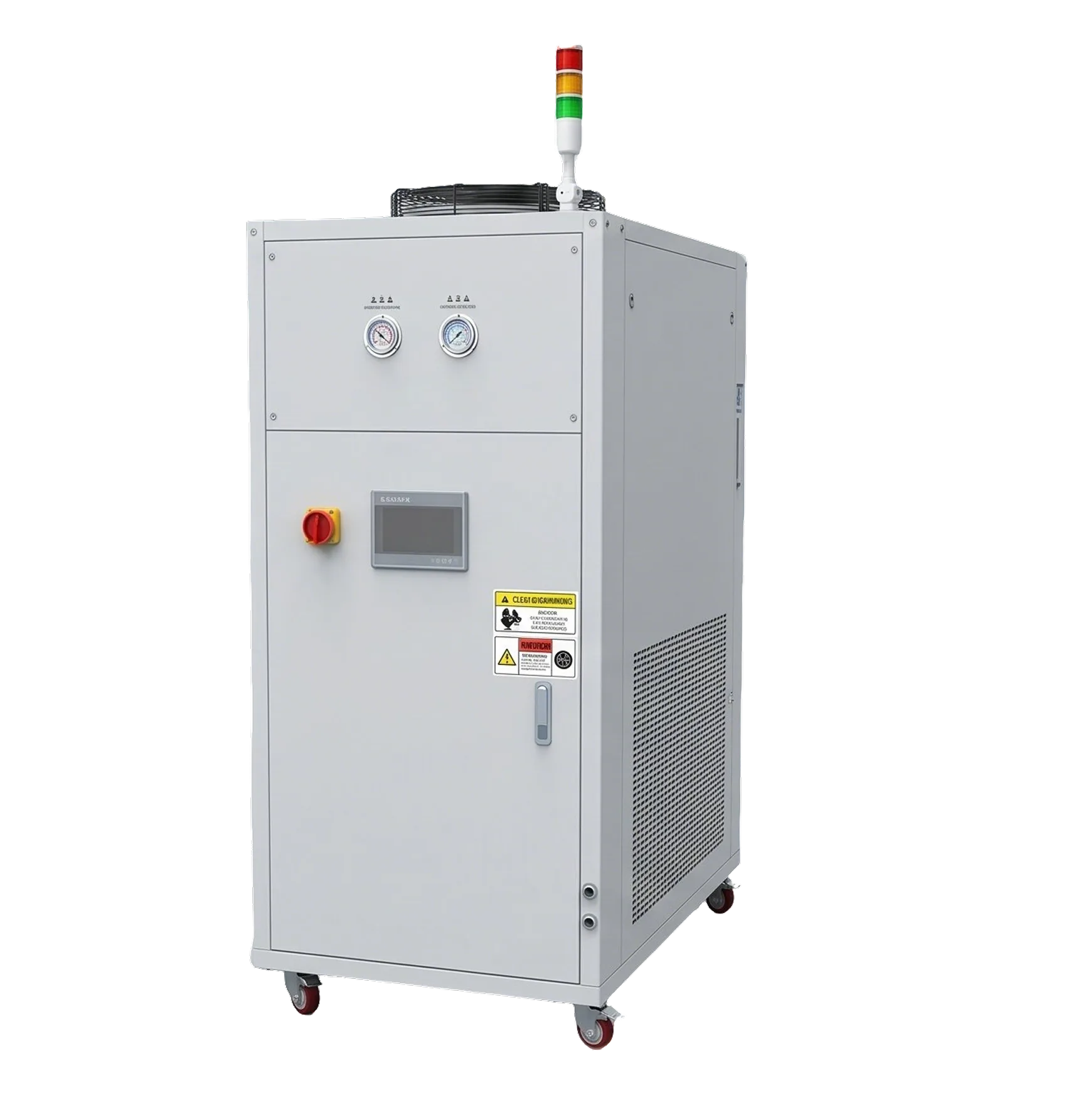
Coolant supply and return temperatures, flow, pressure and device temperatures should be measured at appropriate locations. Control accuracy should not be confused with overall test uncertainty; sensor calibration, placement and response time all contribute. Data logging and communication interfaces are important for automated sequences. For broader project planning, Tekin Cooling’s industrial chiller solutions provide additional technical context for system selection.
Size refrigeration and heating for the battery heat load plus the required ramp rate. A system capable of holding one steady temperature may not move a large thermal mass quickly between extremes. Provide thermal mass, heat generation, coolant volume, temperature range, ramp rate, flow, pressure and test sequence.
The same liquid-conditioning principles can apply to inverters, power modules and semiconductor devices that use cold plates. These components can have fast heat-load changes, so control response and flow stability are important. Where the application requires a connected or alternative cooling approach, see Tekin Cooling’s temperature control units for related equipment options.
EV battery cooling validation requires more than a cold fluid source. The test system must reproduce temperature, flow, pressure and transient conditions in a controlled and measurable way. Coordinating liquid conditioning with environmental chambers and instrumentation creates a stronger foundation for development testing.
Thermal cycling follows repeated temperature profiles; thermal shock generally uses faster or more abrupt transitions.
Many battery packs use liquid thermal management, so a controlled loop can reproduce vehicle coolant conditions.
No. The chamber controls ambient conditions while the conditioner controls the liquid circuit.
Temperature range, heat load, thermal mass, ramp rate, coolant, flow, pressure, volume and test sequence.