A data center’s cooling infrastructure must support continuous IT operations while managing electricity consumption, maintenance requirements and future capacity growth.
Unlike many industrial applications, where a short cooling interruption may stop a production line, inadequate cooling in a data center can cause server temperatures to rise, trigger equipment protection mechanisms and threaten service availability.
For facility engineers, data center developers and mechanical contractors, choosing a data center chiller system is therefore not simply a matter of purchasing enough refrigeration capacity.
The system must be evaluated as part of the complete cooling architecture, including air-handling or liquid-cooling equipment, pumps, controls, heat rejection and backup arrangements.
This guide examines the purchasing and planning decisions that help operators specify suitable chiller equipment for data center projects.
One of the most important steps in planning data center cooling is identifying the heat generated by the installed and anticipated IT equipment.
Server racks, networking equipment, storage systems and associated electrical infrastructure generate heat that must be removed to maintain acceptable operating conditions.
Floor area alone is not a reliable measure of this requirement.
Two data halls with identical dimensions can have substantially different cooling loads if one contains relatively low-density racks and the other supports high-performance computing equipment.
The starting point should include:
Installed IT power consumption.
Expected peak and sustained IT loads.
Rack power density and distribution.
Heat generated by electrical and supporting equipment.
Cooling-system design conditions.
Planned future IT expansion.
Not all heat loads necessarily pass through the chilled-water system. The facility’s cooling architecture determines which loads the chiller plant actually serves.
A design should therefore distinguish between the total facility heat load and the load assigned to the chilled-water plant.
Suppose a proposed data hall has a design IT load of 600 kW.
If the engineering assessment determines that the chilled-water system must remove 650 kW, including the applicable supporting loads, the required chiller capacity would be evaluated against that 650 kW duty.
Using the standard conversion:
ILLUSTRATIVE PROJECT — NOT A FINAL EQUIPMENT DESIGN
IT design load
Chilled-water duty
Equivalent capacity
This calculation expresses the estimated cooling duty in refrigeration tons. It does not determine the final number or size of chillers.
Those decisions also depend on redundancy, design temperatures, actual equipment ratings and operating strategy.
A chiller’s nominal capacity does not necessarily equal its available capacity at the data center’s actual design conditions.
Cooling performance can vary with chilled-water supply temperature, return temperature, ambient conditions and condenser-water temperature.
For this reason, equipment comparisons should use a consistent operating basis.
A supplier’s quotation should identify the capacity available at the specified design point, rather than relying only on a model’s nominal tonnage.
The buyer should also confirm whether the quoted capacity includes the intended operating conditions for the installation.
For example, an air-cooled chiller operating during extreme summer conditions may deliver different performance from its rating under milder ambient temperatures.
Tekin Cooling offers air-cooled screw chillers for larger cooling duties, including a product listed for data center and manufacturing applications.

The 200RT air-cooled screw chiller product page provides technical specifications that buyers can use as a starting point for a project-specific discussion.
Final suitability should be confirmed against the facility’s actual design requirements.
Cooling redundancy is a major purchasing consideration for data centers.
A facility may require continued cooling when a chiller is undergoing maintenance or experiences an unexpected failure.
However, the redundancy arrangement must reflect the site’s availability objectives and the entire cooling distribution system.
An N configuration provides the capacity required to meet the design load under normal operating conditions.
If the facility needs two chillers to meet its required cooling load, those two units together represent N capacity.
This arrangement does not necessarily provide spare capacity if one unit becomes unavailable.
An N+1 arrangement adds sufficient spare capacity so the system can meet the defined load with one specified component unavailable.
For example, if two equally sized chillers are required for the design load, a third unit of the same capacity may provide an N+1 configuration.
However, the actual redundancy depends on the usable capacity of each unit and how the plant is connected and controlled.
A 2N arrangement provides two independently capable sets of capacity for the defined load.
This can offer a higher level of separation, but it generally requires greater investment and careful coordination across the supporting infrastructure.
| Configuration | General approach | Purchasing consideration |
|---|---|---|
| N | Capacity sufficient for the required load | No inherent spare capacity |
| N+1 | Additional capacity for one defined component failure | Balance availability and capital cost |
| 2N | Two independently capable capacity paths | Higher infrastructure investment and complexity |
Redundancy should not be assessed by counting chillers alone.
Pumps, electrical supplies, valves, controls, heat exchangers and distribution piping can also create single points of failure.
The facility’s engineering team should define the required resilience before equipment quantities are finalized.
Both air-cooled and water-cooled chillers can support data center cooling systems.
The most suitable configuration depends on the site’s climate, utilities, water availability, space and long-term operating priorities.
Air-cooled chillers reject heat directly to outdoor air.
They generally eliminate the need for cooling towers and the associated condenser-water system.
This may simplify certain installation and maintenance requirements, especially where water availability is limited.
However, equipment capacity and efficiency are influenced by outdoor air temperature, and sufficient airflow and installation space are essential.
Water-cooled chillers typically reject heat through a condenser-water circuit connected to cooling towers or other heat-rejection equipment.
They may offer operating advantages under suitable conditions, particularly for larger installations.
However, buyers must account for cooling towers, condenser-water pumps, water treatment and ongoing maintenance.
| Evaluation factor | Air-cooled system | Water-cooled system |
|---|---|---|
| Heat rejection | Outdoor air | Condenser-water system |
| Cooling towers | Generally unnecessary | Typically required |
| Water consumption for heat rejection | Generally none | Depends on tower operation |
| Site requirements | Outdoor space and airflow | Cooling tower and water infrastructure |
| Performance sensitivity | Ambient dry-bulb temperature | Condenser-water conditions |
| Maintenance scope | Chiller and air-side equipment | Chiller plus water-treatment and tower systems |
| Overall economics | Depends on climate and operating profile | Depends on climate, utilities and operating profile |
For data center projects, these alternatives should be compared using annual operating conditions rather than a single efficiency figure.
Data center cooling demand is not necessarily constant.
IT equipment utilization, staged expansion, outdoor weather and cooling-system operating modes can all affect the required refrigeration load.
A chiller that performs well at full capacity may not deliver the best overall energy result when operating for long periods at lower loads.
For this reason, procurement teams should request part-load performance information in addition to full-load efficiency.
Important questions include:
How does efficiency change as the cooling load decreases?
Can multiple chillers be staged efficiently?
What are the minimum stable operating conditions?
How does the plant respond to changes in chilled-water demand?
What additional energy is consumed by pumps and heat-rejection equipment?
These factors influence annual electricity consumption and the cost of operating the complete cooling plant.
The goal is to evaluate the entire system, not just the compressor efficiency of one machine.
Data center operators should evaluate how maintenance will be performed while the facility remains operational.
This requires attention to equipment accessibility, isolation arrangements, spare parts and maintenance procedures.
For example, a redundant chiller may provide little practical benefit if both units depend on a shared component that cannot be serviced without interrupting cooling.
The engineering team should review:
Isolation valves and maintenance bypass arrangements.
Access for compressor and heat-exchanger servicing.
Pump and electrical supply resilience.
Alarm and monitoring integration.
Spare-parts availability.
Service response and maintenance responsibilities.
A maintenance strategy should be developed alongside the equipment selection rather than after installation.
Data center cooling requirements can change significantly as IT equipment is upgraded.
A facility initially designed for conventional air-cooled server racks may later introduce higher-density computing equipment or direct-to-chip liquid cooling.
These technologies can create different water-temperature, flow and heat-exchanger requirements.
A conventional chilled-water plant may remain part of the cooling architecture, but it should not automatically be assumed that every future cooling load will require the same water temperature.
For example, some liquid-cooling systems may be designed to operate at temperatures that allow alternative heat-rejection strategies under suitable conditions.
During procurement, the project team should consider whether the proposed plant can accommodate planned changes without compromising existing cooling requirements.
This does not mean buying substantially more refrigeration capacity than currently needed.
Instead, the design may incorporate staged equipment installation, suitable distribution provisions and a clear expansion strategy.
Purchase price is only one part of the cost of a data center chiller system.
Operating expenses can accumulate over many years, making annual energy use, maintenance and equipment reliability important financial considerations.
A practical cost comparison should include:
| Cost category | Items to evaluate |
|---|---|
| Initial equipment | Chillers, pumps, controls and heat exchangers |
| Installation | Foundations, piping, electrical work and commissioning |
| Heat rejection | Condensers, cooling towers and associated infrastructure |
| Energy | Chillers, pumps, fans and supporting equipment |
| Water | Consumption, treatment and associated operating costs |
| Maintenance | Scheduled service, inspections and replacement components |
| Reliability | Cost implications of downtime and backup arrangements |
| Expansion | Future capacity additions and modifications |
A system with a higher initial cost may be economically justified if its verified annual operating savings offset the difference over the evaluation period.
However, such conclusions should be supported by project-specific energy modelling and realistic cost assumptions.
A well-prepared request for quotation helps manufacturers propose equipment that matches the facility’s requirements.
| Information required | Details to provide |
|---|---|
| Facility type | Enterprise, colocation, edge or other data center |
| Design cooling load | Required chilled-water cooling duty in kW or RT |
| Chilled-water temperatures | Supply and return design temperatures |
| Operating conditions | Outdoor design temperatures and site climate |
| Heat rejection | Air-cooled or water-cooled preference and available infrastructure |
| Redundancy | Required N, N+1 or 2N strategy |
| Electrical requirements | Supply voltage, frequency and electrical constraints |
| Controls | Building management system interfaces and monitoring needs |
| Installation | Available space, acoustic limits and service access |
| Future growth | Planned capacity expansion and operating changes |
| Documentation | Performance data, drawings, manuals and test requirements |
The supplier should also be asked to confirm the applicable rating conditions and any performance limitations.
This reduces the risk of comparing quotations that use different assumptions.
Tekin Cooling supplies industrial refrigeration equipment, including air-cooled screw chillers and integrated chiller systems.
Its industrial chiller integrated system range brings together cooling equipment and supporting components for applications requiring coordinated plant operation.
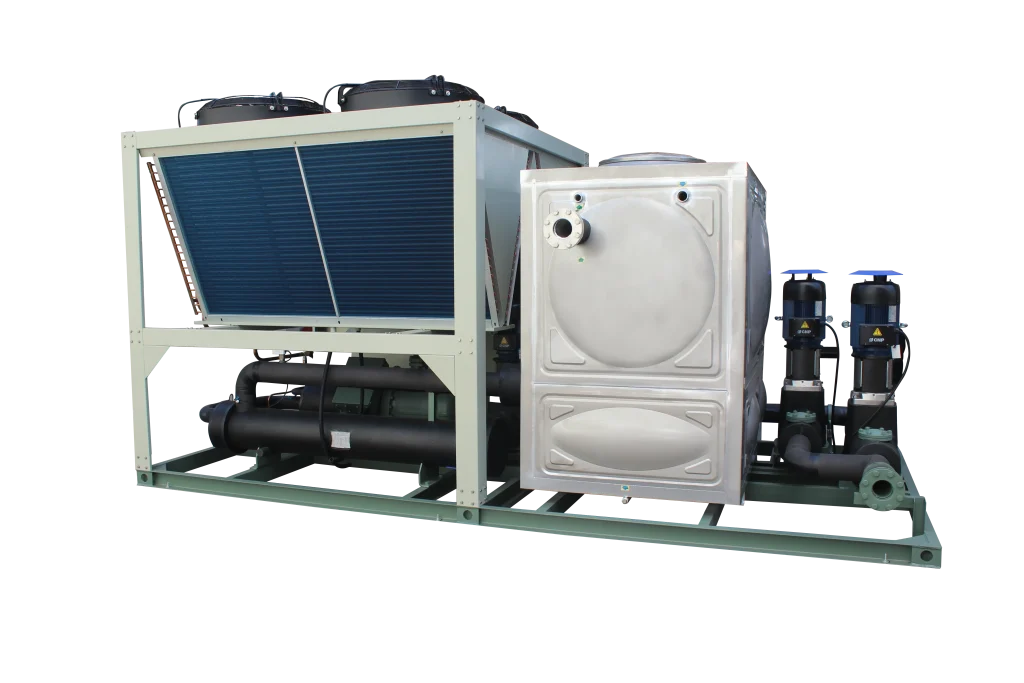
For data center projects, equipment evaluation should begin with the design cooling load, required operating temperatures, redundancy strategy and site conditions.
Tekin Cooling’s published 200RT air-cooled screw chiller is explicitly marketed for data centers and manufacturing applications, making it a relevant product to discuss during preliminary equipment selection.

Final configuration, performance and compatibility must be confirmed through the technical quotation process.
For projects requiring a complete cooling plant, the engineering team should also determine which pumps, controls, distribution components and backup provisions are included in the proposed supply scope.
A data center chiller system removes heat from a chilled-water circuit used by suitable cooling equipment serving IT spaces or associated infrastructure. It is one part of the overall data center cooling architecture.
Capacity depends on the design heat load assigned to the chilled-water system, operating conditions, redundancy requirements and future expansion plans. Floor area alone is insufficient for accurate sizing.
N+1 means providing additional capacity so the required load can still be served when one defined component is unavailable. The arrangement must also account for the wider cooling infrastructure.
Yes. Air-cooled chillers can be suitable for data centers when their capacity, efficiency, site conditions and operational requirements match the project.
Buyers should compare capacity at design conditions, full-load and part-load performance, controls, reliability, documentation, maintenance requirements, equipment scope and long-term operating costs.
Whether you are developing a new data center, expanding an existing facility or reviewing your current chilled-water infrastructure, the right equipment selection starts with a clearly defined cooling requirement.
Tekin Cooling can evaluate suitable industrial chiller options based on your project’s cooling load, operating temperatures, site conditions and equipment configuration.
Contact Tekin Cooling or email info@tekincooling.com to discuss your data center cooling requirements and request a technical quotation.